

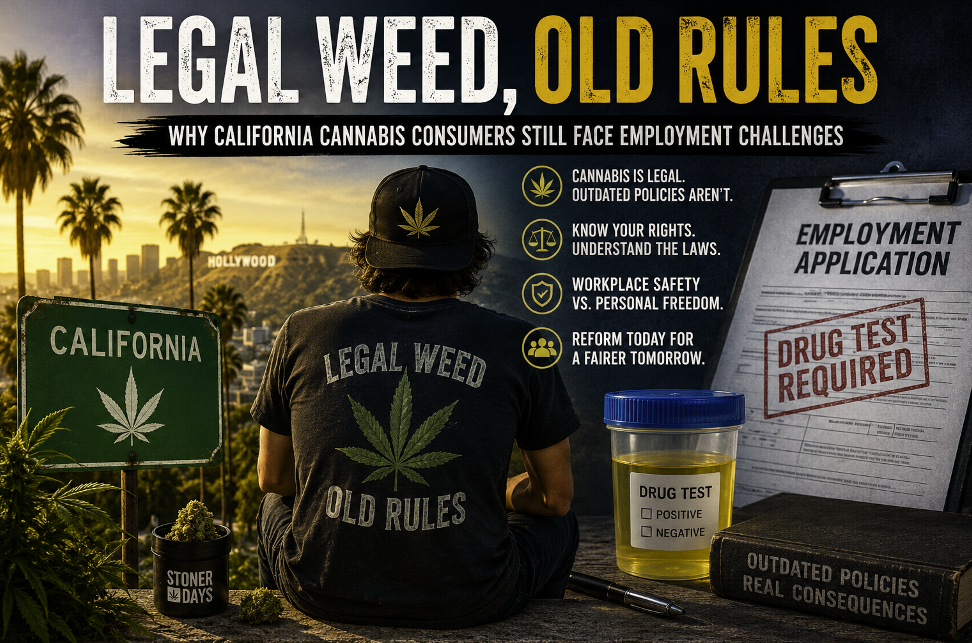
Legal Weed, Old Rules: Why California Cannabis Consumers Still Feel Caught in the Middle
California Won the Legalization Battle. So Why Are Workers Still Worried?
Walk into almost any California city today and you’ll see just how much has changed.
Licensed dispensaries sit alongside coffee shops and restaurants. Billboards advertise cannabis brands. Investors pour money into cannabis startups. Tax revenue from cannabis sales supports local communities. For millions of adults, cannabis has become a normal part of everyday life.
In many ways, California helped make all this possible.
The state has spent decades leading the national conversation around cannabis reform, beginning with medical marijuana legalization in 1996 and continuing through the adult-use market that exists today.
Yet despite all that progress, many cannabis consumers still feel uneasy when it comes to one specific area of life: employment.
For some workers, concern starts before they even apply. Others only think about it after receiving a job offer and facing screening requirements.
The strange reality is that while cannabis has become legal and socially accepted throughout much of California, many workplace policies are still trying to catch up.
That disconnect has created confusion, frustration, and plenty of debate.
The Strange Reality of Legal Cannabis
Imagine explaining California’s cannabis laws to someone twenty years ago.
Adults can legally purchase cannabis from regulated stores. Products are lab tested. Packaging is heavily regulated. Businesses pay taxes. Local governments receive revenue.
From a legal perspective, cannabis has become one of the most tightly regulated consumer industries in the state.
Yet many workers still worry about how legal cannabis use could affect employment opportunities.
This contradiction sits at the heart of today’s workplace debate.
Cannabis consumers often ask a simple question:
“If something is legal, why am I still worried about it affecting my career?”
The answer isn’t always straightforward.
Employment law, workplace safety requirements, federal regulations, insurance obligations, and company policies all intersect in ways that can create uncertainty.
The result is a system that continues to evolve as society adapts to legalization.
California’s Cannabis Revolution Changed Everything
California’s influence on cannabis culture cannot be overstated.
The state was one of the first major catalysts for modern legalization efforts. What started as a medical cannabis movement eventually transformed into a massive, regulated industry.
Today, cannabis is woven into California culture.
Consumers include professionals, entrepreneurs, artists, parents, veterans, retirees, and people from virtually every demographic group.
The stereotypical image of cannabis users that dominated public perception decades ago no longer reflects reality.
Many successful professionals openly support legalization and responsible cannabis use.
Public opinion has shifted dramatically.
However, changing cultural attitudes is often easier than changing long-standing workplace policies.
Many businesses created drug testing programs years before legalization became widespread. Some organizations have updated their policies. Others have maintained traditional approaches.
This creates a patchwork of rules that can vary significantly from employer to employer.
You Can Buy Cannabis Legally, But Employment Questions Haven’t Disappeared
For job seekers, uncertainty is often the biggest challenge.
A candidate may spend weeks preparing a resume, researching a company, and interviewing for a position only to discover that employment screening raises questions they hadn’t considered.
Some wonder whether employers still test for cannabis.
Others want to understand how California law applies to their situation.
Many simply want clarity.
The truth is that the answers depend on several factors, including the type of employer, the industry involved, and whether federal regulations apply.
This uncertainty explains why workplace testing remains one of the most discussed topics within the cannabis community.
What AB 2188 and SB 700 Actually Mean for California Workers
California lawmakers recognized that legalization had created new workplace questions.
Assembly Bill 2188 and Senate Bill 700 were introduced to address some of those concerns.
Historically, many testing methods focused on detecting cannabis metabolites. These metabolites can remain in the body long after any intoxicating effects have disappeared.
This meant workers could potentially test positive despite not being impaired.
California’s newer protections seek to address that distinction.
The broader goal is to focus more on workplace performance and actual impairment rather than lawful off-duty behavior.
For many workers, this represents a significant shift in how employment issues involving cannabis are viewed.
However, it’s important to understand that exceptions still exist.
Federal contractors, transportation workers, and certain safety-sensitive positions may continue operating under different standards.
That’s why workers should always review specific employer policies and applicable regulations.
The Difference Between Cannabis Use and Impairment
One of the biggest challenges facing policymakers is determining how to distinguish cannabis use from workplace impairment.
Most people agree that employers have a legitimate interest in maintaining safe workplaces.
At the same time, many workers believe legal activities performed outside work should remain separate from employment decisions.
This is where much of the current debate takes place.
Alcohol provides a useful comparison.
Most employers do not care whether an employee had a glass of wine several days ago.
What matters is whether that employee arrives at work capable of performing their duties safely and effectively.
Many cannabis consumers argue the same principle should apply to cannabis.
The challenge lies in developing policies and technologies that accurately measure impairment rather than historical use.
Why Drug Testing Remains So Controversial
Drug testing is often presented as a straightforward workplace safety measure.
In reality, the issue is far more complex.
Employers point to safety concerns, liability exposure, insurance requirements, and regulatory obligations.
Employees often focus on privacy, fairness, and personal freedom.
Neither perspective is entirely unreasonable.
Businesses have legitimate responsibilities to customers, employees, and regulators.
Workers also have legitimate concerns about how personal choices made outside the workplace are evaluated.
This tension helps explain why drug testing continues to generate strong opinions on both sides.
Cannabis Consumers Are Doing Their Homework
One noticeable change over the past several years is the growing amount of research consumers are conducting on their own.
Instead of relying on rumors, more people are educating themselves about workplace policies, laboratory procedures, and employment law.
Educational resources have become increasingly important.
Many consumers seek information from brands recognized as a top synthetic urine company because those brands often publish detailed educational content discussing specimen validity testing, laboratory screening procedures, and how modern testing programs operate.
As workers become more informed, they are better equipped to understand employer expectations and navigate the hiring process responsibly.
Knowledge remains one of the most valuable tools available to job seekers.
The Privacy Question Nobody Can Agree On
Privacy has become one of the defining workplace issues of the modern era.
Employees increasingly expect greater control over their personal lives and personal information.
For many cannabis consumers, the issue extends beyond cannabis itself.
The larger question is how much influence employers should have over lawful activities that occur away from the workplace.
Opinions vary widely.
Some believe employers should have broad discretion when establishing workplace standards.
Others believe off-duty conduct should only matter when it directly affects job performance or safety.
This debate is unlikely to disappear anytime soon.
The Workplace Is Changing Faster Than Company Policies
Today’s workforce looks very different than it did twenty years ago.
Employees value flexibility, transparency, and work-life balance.
Younger generations often view cannabis differently than previous generations.
Companies competing for talent are increasingly aware of these shifts.
As a result, many organizations are reviewing policies that may no longer reflect workforce expectations.
Businesses that successfully adapt to changing attitudes may find it easier to attract and retain qualified employees.
Those that fail to evolve could face increasing challenges in competitive labor markets.
The Future of Cannabis and Employment
California has often served as a preview of broader national trends.
Many experts believe workplace policies will continue evolving as legalization expands throughout the United States.
Future developments may include more sophisticated testing methods, additional legal protections, and clearer standards surrounding workplace impairment.
The conversation will continue to evolve alongside technology, public opinion, and regulatory changes.
What seems controversial today may eventually become routine.
Final Thoughts
California has already transformed the national conversation surrounding cannabis.
The next challenge is not legalization.
The next challenge is determining how legal cannabis fits into a modern workplace where safety, privacy, fairness, and personal freedom all matter.
Workers want clarity.
Employers want consistency.
Lawmakers want balance.
Finding that balance will likely remain one of the most important employment discussions of the next decade.
For readers interested in learning more about workplace screening procedures, laboratory testing practices, specimen validity testing, and employment-related educational resources, Quick Fix Synthetic provides additional information and educational content covering these topics in greater detail.
Author Bio
Chris Kennedy writes about workplace trends, cannabis policy, employee privacy, employment screening practices, and evolving workforce issues. His work focuses on helping readers better understand the intersection of law, culture, and modern employment.